The Pentatonic Nights of Addis Ababa: Mulatu Astatke and an Interrupted Jazz Age
When spider webs unite, they can tie up a lion.
Ethiopian proverb
For most of the world, Ethiopia froze in 1984. That year the cameras reached the camps in the north, and television audiences saw cracked earth and hungry children, followed by tens of thousands singing together at Live Aid. Ever since, the country has carried a single word in the international memory: famine.
Turn the dial back twenty years, though — to Addis Ababa in 1966 — and you hear something else entirely. A highland city at 2,400 metres, cold at night, the air thin enough to make brass sound unusually bright. On the stages of its bars and clubs there were bands in suits, drummers playing Latin patterns, saxophones playing bebop. And behind the vibraphone, a young man was folding all of it into a different mode.
The man who retuned jazz to the shape of Ethiopia — Mulatu Astatke
Mulatu Astatke was born in 1943 in Jimma, in the south-western valleys where coffee comes from. His father wanted him to learn a useful trade and sent him to Wales to study engineering. There he heard jazz for the first time, and put the engineering down.
He moved to Berklee in Boston, then a young school, and became one of its first African students.
At Berklee he ran into a problem nobody else regarded as a problem. Ethiopian traditional music is pentatonic — five notes to the octave. Jazz harmony is built on twelve, with sevenths, ninths and altered tones packed in densely. Set Western chords under an Ethiopian melody and it always looks like a suit tailored over national dress.
His solution was to invert the question: don't fit chords to the melody, treat the Ethiopian modes themselves as the harmony. Highland music has four qenet — tezeta (nostalgia), bati, ambassel, anchi hoye. Change the mode under the same tune and longing turns into warning. Mulatu laid those modes down as a bed of metallic vibraphone colour and let the horns and congas walk over them. That is what came to be called Ethio-jazz.
He went home to Addis Ababa in 1966. The eight years that followed were the city's best, and people later gave them a name: Swinging Addis. In 1973 Duke Ellington's tour reached Addis, and Ellington stepped up to play with Mulatu's band — a man who had written jazz into the textbooks, standing on a stage in the African highlands.
The instrument: the krar, and homesickness on five strings
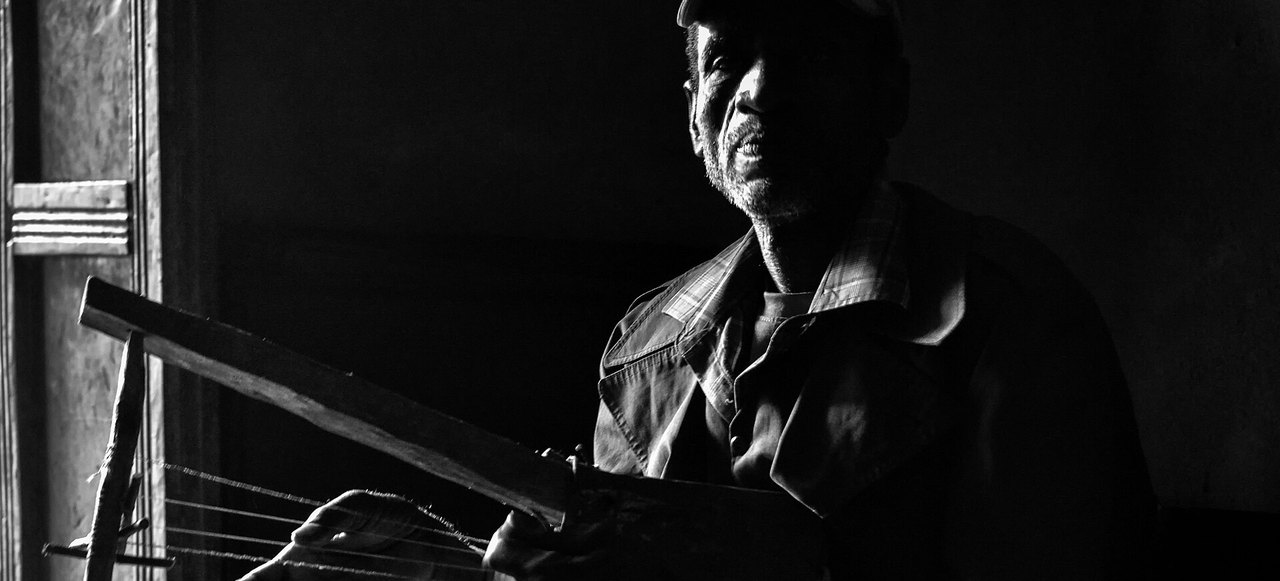
To understand that five-note world, look at an instrument: the krar. A lyre with a bowl-shaped wooden body covered in hide, five or six strings, played with a plectrum.
It is almost crude in its simplicity, and precisely because of that it shaped how an entire plateau hears. No semitones, no modulations to speak of: melody can only move through timbre, ornament and rhythm. A krar player will worry a single note — rubbing, bending, sliding — and put the whole emotion into the gaps between those five notes.
Then there is the masenqo, a single-string bowed fiddle, thin and piercing, like someone crying far away. Singers deliberately let the voice sit against the string until you cannot tell which is the person and which is the instrument.
So when Mulatu put a vibraphone on stage, he was doing something quietly radical: using a Western, metal, fixed-pitch instrument to take on the krar's role. Not replacing it — translating its atmosphere into another material.
1974: the door closes
1974. Emperor Haile Selassie is overthrown and the Derg takes power. Curfews, censorship, purges. The clubs close, the bands scatter, jazz is reclassified as Western decadence.
Musicians left in numbers. Mulatu went to the United States and made a living teaching and arranging for twenty years. In those two decades his records sat in second-hand shops around the world, un-reissued, unmentioned. Swinging Addis became a decade without an archive.
The turn came from a Frenchman. In the 1990s Francis Falceto began compiling a series for Buda Musique called Éthiopiques, digging out Ethiopian recordings of the 1960s and 70s one track at a time. Volume four was given over entirely to Mulatu.
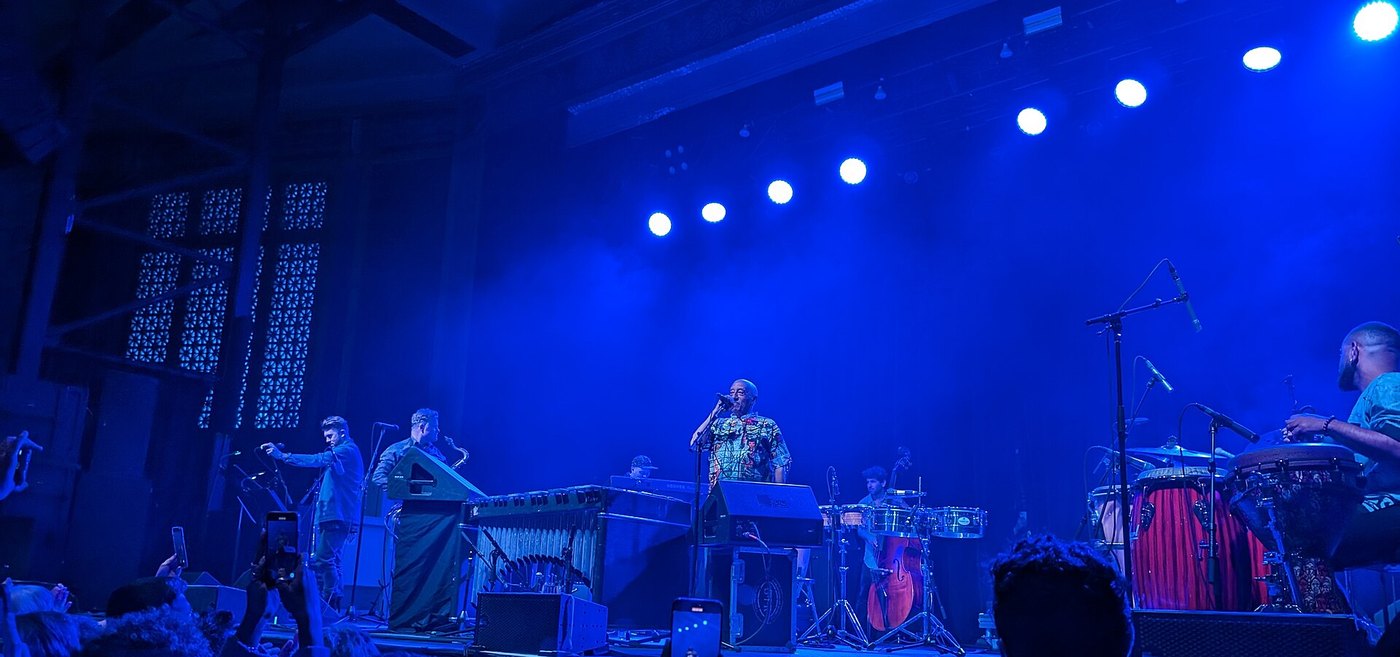
Then in 2005 Jim Jarmusch used his music in Broken Flowers. That suspended, semitone-free melody, set against Bill Murray's face on a sofa, let filmgoers everywhere hear an Addis Ababa night for the first time. After that came Either/Orchestra and the Heliocentrics, festival stages, tours starting again — including the one in the photograph: 2024, eighty-one years old, still on stage.
Straight to the radio
Further: follow the thread
Wikipedia · Mulatu Astatke (the fullest chronology and session list)
Now open the Ethiopia page and pick any station. Odds are you will hear contemporary pop with no connection to the sixties at all, and that is fine. But once in a while, on some late-night programme, you will run into a melody hanging in mid-air: five notes, circling, refusing to land. That is the fingerprint this highland country left on the world's music.